Jaw and Facial Pain Evaluated as a Movement Problem
TMJ Therapy in Lake Charles for jaw discomfort, limited movement, clicking, and symptoms extending into the head and neck
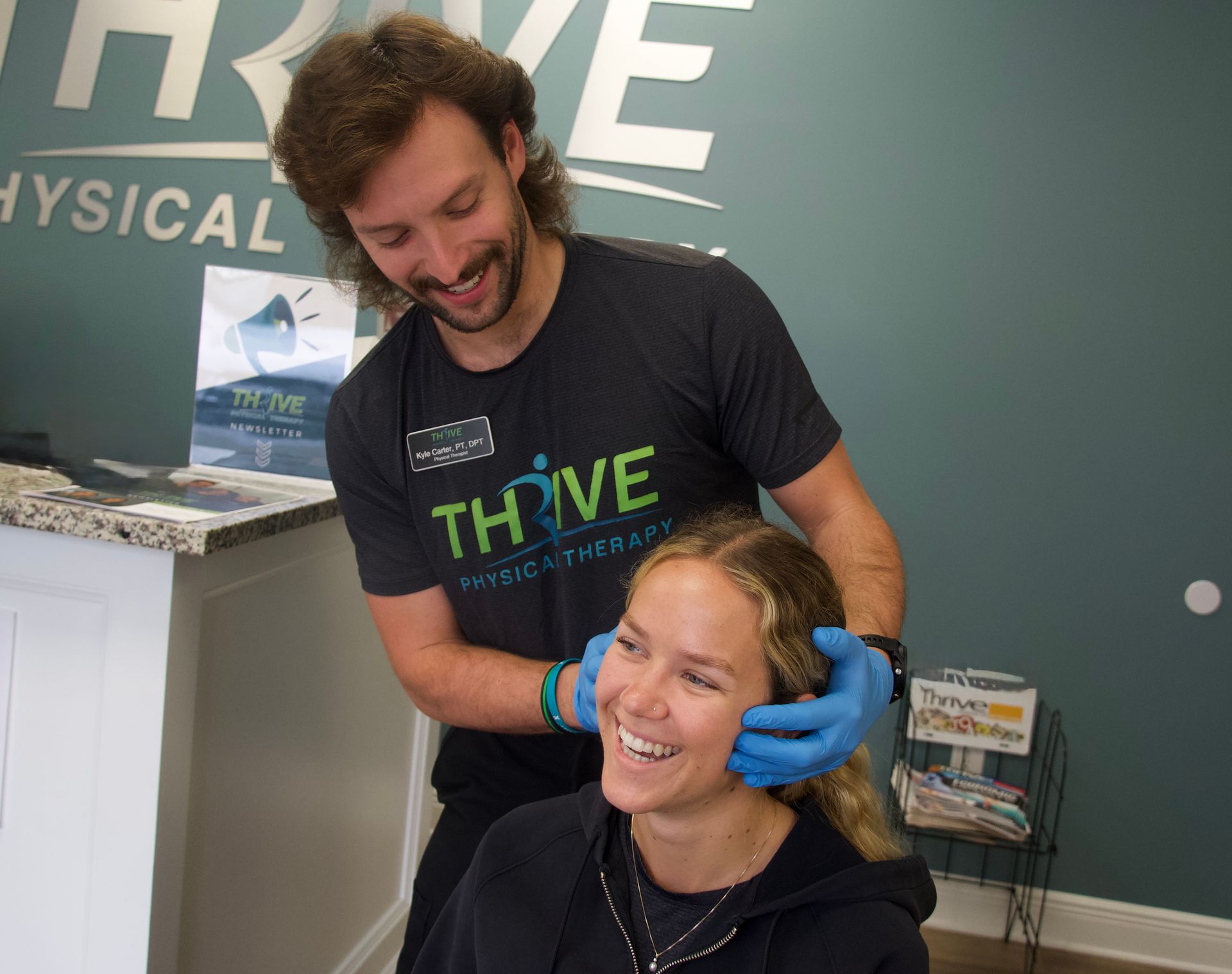
Jaw-related symptoms rarely stay confined to the jaw itself—clicking during movement, limited mouth opening, facial discomfort, and recurring headaches are frequently connected to restrictions in joint mechanics, surrounding muscle tension, and posture patterns that a physical therapy evaluation is designed to identify. Thrive Physical Therapy provides specialized TMJ therapy in Lake Charles, led in part by Kyle Carter, a credentialed Sports and TMJ Specialist whose clinical training focuses specifically on jaw dysfunction and its relationship to the surrounding musculoskeletal system. Patients managing persistent jaw symptoms that haven't resolved with dental treatment or time are often appropriate candidates for a movement-focused evaluation.
TMJ physical therapy begins with an assessment of jaw movement range, joint mechanics, surrounding muscle function, cervical posture, and mobility of the neck and upper spine—areas that frequently contribute to jaw-related symptoms and are often overlooked when evaluation focuses only on the jaw joint itself. That systematic assessment guides a treatment plan that may incorporate manual techniques, therapeutic exercise, postural correction, and patient education tailored to what the findings reveal.
Schedule an assessment at Thrive to evaluate the mechanical factors contributing to your jaw symptoms.
What the TMJ Evaluation Process Involves
The initial TMJ evaluation documents jaw movement in multiple directions, joint sounds during movement, palpation findings at the masseter, pterygoid, and temporalis muscles, and assessment of cervical mobility and posture—because the neck and jaw share functional relationships that affect how both areas move and respond to treatment. Kyle Carter's specialized training in TMJ assessment means these anatomical connections are part of the evaluation framework, not an afterthought.
After evaluation is complete and treatment begins, patients often notice changes in jaw movement range, shifts in the frequency of clicking or catching during movement, and altered muscle tension patterns in the jaw and temples. These observations are documented through formal reassessment rather than assumed based on treatment alone.
TMJ physical therapy addresses the musculoskeletal components of jaw dysfunction—joint mobility, muscle function, posture, and movement patterns—and may work alongside dental management when the presentation involves both mechanical and bite-related factors. It is not a replacement for dental or orthodontic care when those interventions are indicated.
Answers to Common TMJ Therapy Questions
Physical therapy for jaw symptoms is unfamiliar to many patients, who more commonly receive dental referrals for TMJ-related complaints. These answers address how evaluation and treatment work at Thrive Physical Therapy.
What does a TMJ physical therapy evaluation involve?
The therapist assesses jaw movement range, joint mechanics, muscle tension in the jaw and surrounding structures, cervical posture, and neck mobility to identify contributing factors.
Who performs TMJ therapy at Thrive?
Kyle Carter, a credentialed Sports and TMJ Specialist, leads TMJ evaluation and treatment as part of Thrive's clinical services.
Why do jaw symptoms often extend into the neck and head?
The jaw joint, surrounding muscles, and cervical spine function in close anatomical relationship, meaning restrictions or tension in one area frequently affect how adjacent structures move.
When is physical therapy the appropriate approach for jaw symptoms?
Physical therapy addresses musculoskeletal contributors to jaw dysfunction—when discomfort, clicking, or limited movement persists despite rest or dental treatment, a movement-focused evaluation may identify mechanical factors.
What types of treatment are typically included in a TMJ plan?
Treatment may involve manual techniques applied to the jaw joint and surrounding tissues, cervical mobility work, therapeutic exercise, and postural education depending on evaluation findings.
Thrive Physical Therapy offers specialized TMJ evaluation and treatment for patients managing persistent jaw symptoms, headaches, and related neck complaints. An intake session with Kyle Carter begins with a full mechanical assessment of the jaw, surrounding musculature, and cervical region.
Speak With A Board Certified Specialist Today!
Is your pain making it difficult for you to concentrate?
Are you hoping it will just go away but it’s still hurting you?
If you answered “Yes” to any of those questions, you should call us and make an appointment to see one of our qualified Physical Therapist. We will interview you, find out your problem, layout the customized plan for you and work with you personally.
Call one our offices now at (337) 990-5621 or request an appointment:

Ask a Specialist
Contact Us
We will get back to you as soon as possible.
Please try again later.